Catalog “Luca Scacchi Gracco. Artist and Adventurer”, curated by Denis Isaia and Manuela Vallicelli, Mart Editions.
Mart, Museum of Modern and Contemporary Art of Trento and Rovereto.
Texts by: Vittorio Sgarbi, Manuela Vallicelli, Jean Blanchaert, Sergio Restelli, Marco Meneguzzo.
Interviews by Deni Isaia whit: Greta Scacchi, Paul Scacchi, Tom Scacchi e Sarah Scacchi Gracco.
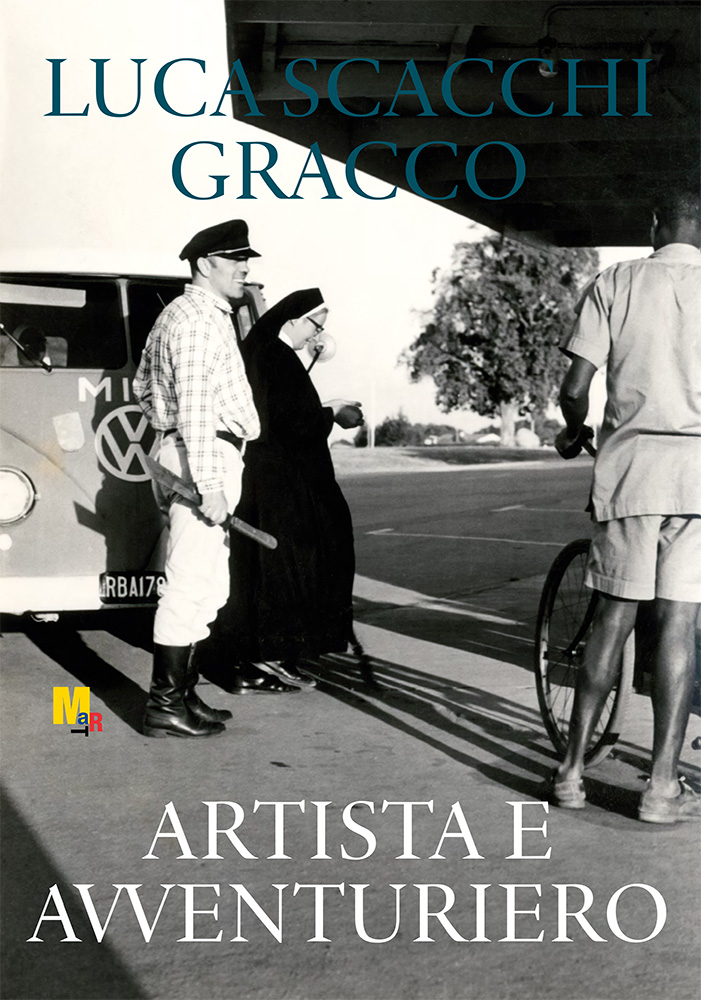
Catalogue cover
Nota editoriale
Il testo che segue è un estratto dalla seconda parte del mio saggio “Dove nessuno è mai giunto prima”, scritto in occasione della mostra dedicata a Luca Scacchi Gracco.
Con il consenso degli aventi diritto, pubblico qui l’ultima parte del testo in versione italiana e inglese. Il saggio completo è incluso nel catalogo della mostra, attualmente in vendita.
Editorial note
The following text is an excerpt from the second part of my essay “Where No One Has Ever Gone Before”, written for the exhibition dedicated to Luca Scacchi Gracco.
With the consent of the rights holders, I am publishing here the final part of the text in both Italian and English. The complete essay is included in the exhibition catalogue, currently available for sale.
(Segue testo in italiano)
Nel 1954 a Parigi l’amico Jacques Prévert gli presentò Picasso che lo ospitò per tre mesi a Cannes dandogli uno spazio per dipingere. A Luca non interessava esibire le proprie opere, ha portato avanti la sua ricerca sempre in silenzio, più che un pittore, infatti, si considerava un filosofo, “c’è un pensiero dietro” diceva. In questa mostra oltre alle tele esposte è presente un collage del 2010, espressione dell’ultimo periodo che riguarda la meccanica, il disordine e i pianeti, collage pensato per essere proiettato su parete. Mentre allestivamo la mostra mi è venuta in mente la prima che curai per Luca Scacchi Gracco nel 2009 insieme a Grazia Chiesa presso lo Studio D’Ars di Milano. Ricordo che non aveva tele in studio, ho scoperto anni dopo che le conservava in un deposito, quindi abbiamo esposto ottime riproduzioni dei suoi lavori di gioventù e la nuova produzione in collage a cui stava lavorando. Dietro nostro invito la mostra fu inaugurata da Philippe Daverio e Jean Blanchaert con una grande presenza di pubblico. Il titolo era “Ritorneranno le piramidi”, il comunicato stampa venne scritto da me e da Luca utilizzando testi dal libro d’artista che mi aveva chiesto di realizzare, una richiesta da pittore a pittrice. Il libro d’artista ora è pronto e verrà presto pubblicato. Nel 2010 Luca Scacchi Gracco presentò una mia personale organizzata dalla Fondazione D’Ars presso la galleria 9 Colonne a Milano, per quell’occasione scrisse nel comunicato stampa: “Manuela Vallicelli crede nel vento, nel fuoco, nella terra e nell’onda. Riesce a scomporre il cielo, il ghiaccio vince la montagna e il fuoco la taglia. Dall’orizzonte si raggiunge il rovesciamento, rotolamento di foreste e colline. Oltre la sfera di questa realtà l’orizzonte è l’ellittica dell’universo. Gli strati sono il cielo e il mare e quando il cielo e il mare si spostano succede il ribaltamento. Gli elementi si sovrappongono con una dinamica dal passato al futuro. Il fiume è una poesia legata alla primordialità. In queste grandi solitudini Manuela Vallicelli ha addomesticato il vento, il cielo e le montagne. Lei possiede gli elementi al di là della forma, elementi come l’acqua, il caldo, il freddo, la nebbia e il tempo. La prospettiva non le interessa, la distanza è data dall’aria che dipinge. Manuela respirando il paesaggio vede gli elementi che precipitano, è un vulcano in eruzione, il tramite tra il sottosuolo e il cielo, tra il passato e il futuro.”
Luca era come sarà l’uomo del futuro. Un uomo che vive per l’arte e nell’arte.
(English version)
In 1954, in Paris, his friend Jacques Prévert introduced him to Picasso, who hosted him for three months in Cannes, giving him a space to paint. Luca was not interested in exhibiting his own works; he pursued his research quietly throughout his life. More than a painter, he considered himself a philosopher, “there is a thought behind it,” he used to say. In this exhibition, in addition to the canvases on display, there is a collage from 2010, an expression of his final period focused on mechanics, disorder, and planets, a collage conceived to be projected onto a wall. While setting up the exhibition, I found myself thinking of the first one I curated for Luca Scacchi Gracco in 2009 together with Grazia Chiesa at Studio D’Ars in Milan. I remember that he had no canvases in his studio; only years later did I discover that he kept them in storage. We therefore exhibited high-quality reproductions of his early works and the new collage production he was working on. At our invitation, the exhibition was inaugurated by Philippe Daverio and Jean Blanchaert, with a large public turnout. The title was The Pyramids Will Return. The press release was written by Luca and me, using texts from the artist’s book he had asked me to create, a request from painter to painter. The artist’s book is now complete and will soon be published. In 2010, Luca Scacchi Gracco presented a solo exhibition of mine organized by the Fondazione D’Ars at the 9 Colonne gallery in Milan. On that occasion, he wrote in the press release: “Manuela Vallicelli believes in wind, fire, ground and waves. She manages to break down the sky, the ice conquers the mountain and the fire cuts into it. The world overturns from the horizon, forests and hills roll down. Beyond the scope of this reality, the horizon is the elliptical of the universe. The layers are the sky and the sea and when they move, they roll over. Elements overlap with a dynamic from the past to the future. The river is a poem related to primordial time. In these great solitudes Manuela Vallicelli has tamed the wind, the sky and the mountains. She possesses the elements beyond the shape, elements such as water, heat, cold, fog and time. She is not interested in perspective, the distance is given by the air she paints. While breathing the landscape she sees the elements falling, she acts as an erupting volcano, the intermediary between the underground and the sky, between the past and the future.” Luca was, and will be, the man of the future. A man who lives for art and within art.
© Testo pubblicato con autorizzazione. Tutti i diritti riservati.
© Text published with permission. All rights reserved.
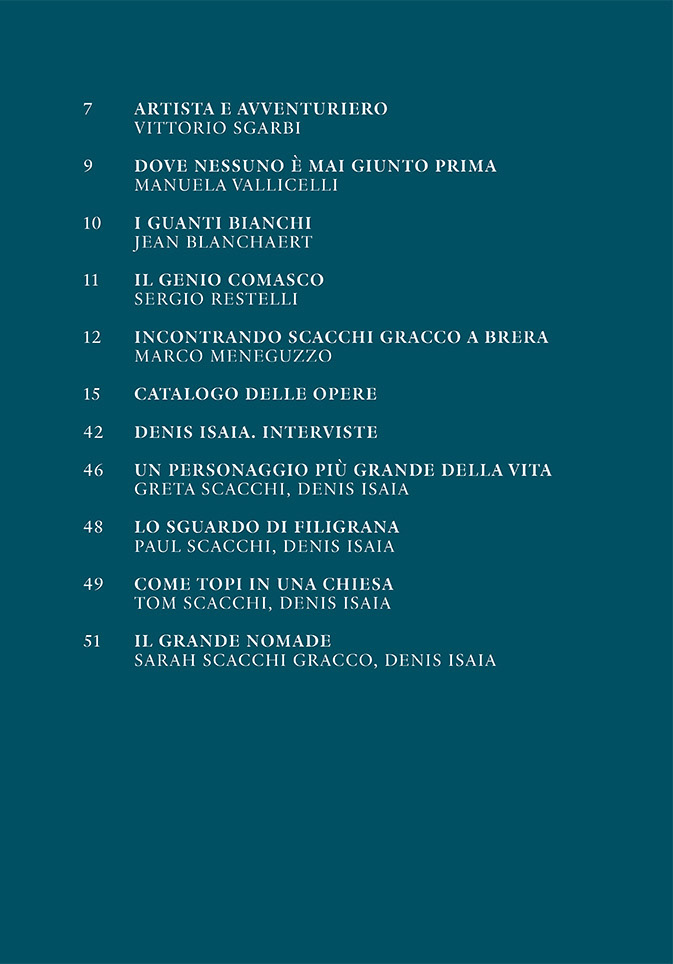
Indice / Table of Contents
 Manuela Vallicelli